

During its next meeting, the Ocala City Council will consider a series of changes to increase current or impose new rates associated with water and sewage, including the imposition of escalating impact fees for new development and increases in residential water rates over the next four years.
The associated ordinance and resolution will be discussed during the council’s regular meeting on Tuesday, June 17.
The city last conducted a water study in 2021 for water, wastewater and reclaimed water, implementing rates based on that study. The associated rates and charges were codified in Chapter 70 of the city’s Code of Ordinances. Among the provisions of the adopted rate study in 2021 was a “built-in” rate adjustment for future years, ending in 2025. The last update occurred on October 1, 2024.
Last year, the city hired Raftelis Financial Consultants, Inc. (Raftelis) to perform a new study and develop a revised financial forecast for the future of the city’s utilities. The company was tasked with determining what current and future rate adjustments are necessary to ensure the city is aligned with that forecast, according to a report by Raftelis.
In its report, the consultancy group outlines a series of proposed water and wastewater rate and fee adjustments to “support the revenue requirements projected” for the city’s water system. That includes “updated impact fees to recover the capacity-related costs to serve new development.”
Raftelis says that, despite maintaining a “balanced utility budget each year,” the water and wastewater rates in the city have “not kept pace with increasing operating costs.”
“For the past several years, revenues have only been adequate to fund operating expenses, existing debt service payments and the General Fund Transfer, and a portion of the annual capital maintenance requirements,” reads a portion of the company’s report.
According to the consultancy group, the city’s Water Resources Department has primarily funded major capital projects through the use of cash reserves and has significantly reduced those reserves over time. The company says the diminished reserves essentially “limit the city’s ability to fund future capital projects without adjusting water and wastewater rates.”
The report also proposes a series of adjustments to the “System Impact Fees to be recovered from new development,” as well as increases to the existing miscellaneous utility fees and charges, and recommendations to implement new fees for services being provided.
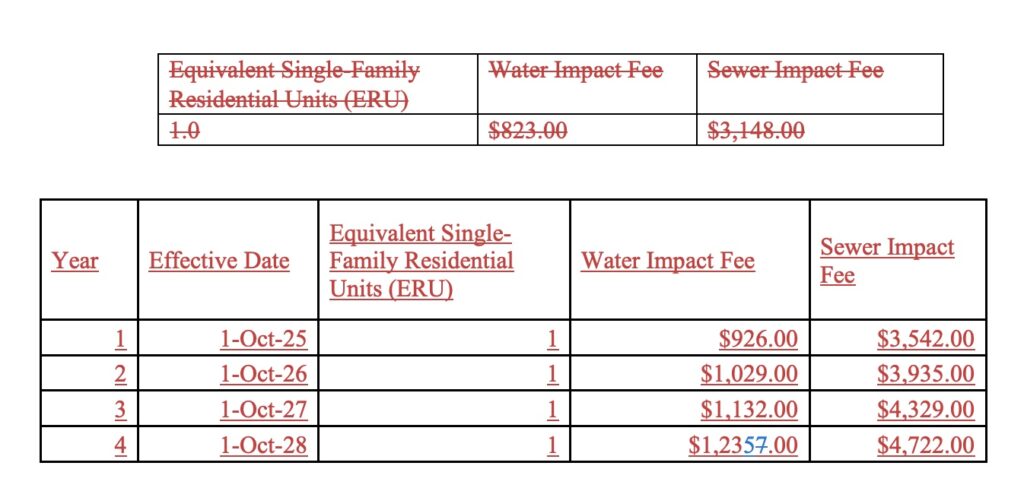
The proposed impact fee changes would increase the water impact fee and sewage impact fees every year through 2028:

In addition to the impact fees impacting new development, the company also outlined changes to current water and wastewater rates. According to Raftelis, a new proposed rate schedule for users would generate a “combined monthly water and wastewater bill increase” of around 5% on average.
In its report, the company estimated that an average Ocala customer using 6,000 gallons a month would incur a cost increase of just over $4 each year, making their bill $90.79 (as opposed to $86.46).

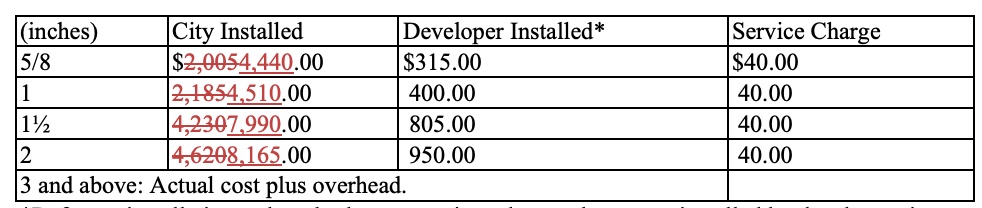
Another notable change includes a large increase in the charge for setting meters. The new schedule doubles or nearly doubles the previous rates:
In addition to updating the water utility rates, Raftelis was also asked to consider and review miscellaneous utility charges, including connection charges, temporary water service charges and meter test fees.
The proposed ordinance shows that the new miscellaneous charges would include a “water meter disconnection for non-payment” charge that would vary during business ($65) and non-business ($160) hours.
Customer-requested site visits that aren’t otherwise specified would cost $65 during business hours and $160 after business hours, which end at 3 p.m.

The ordinance would also implement new industrial permitting fees and establish a definition for “tampering” with water systems and meters, as well as associated consequences.
The city staff report indicates that the adoption and imposition of the charges and fees outlined in the ordinance would “shift the burden of these costs from the entire body of water utility service customers to the actual customers responsible for the provision of the services.”
The staff report goes on to suggest that adoption of the ordinance and resolution and the imposition of the charges and fees is in the “best interest of and protects the health, safety and welfare of the City of Ocala” and its citizens.
If approved, the revisions and new rates would go into effect beginning October 1, 2025.
What are your thoughts about the topic? Share them in a comment below or, if you have more to say on the topic, write us a letter.
The Ocala City Council next meets on Tuesday, June 17, at 4 p.m. at Ocala City Hall (110 SE Watula Avenue).