
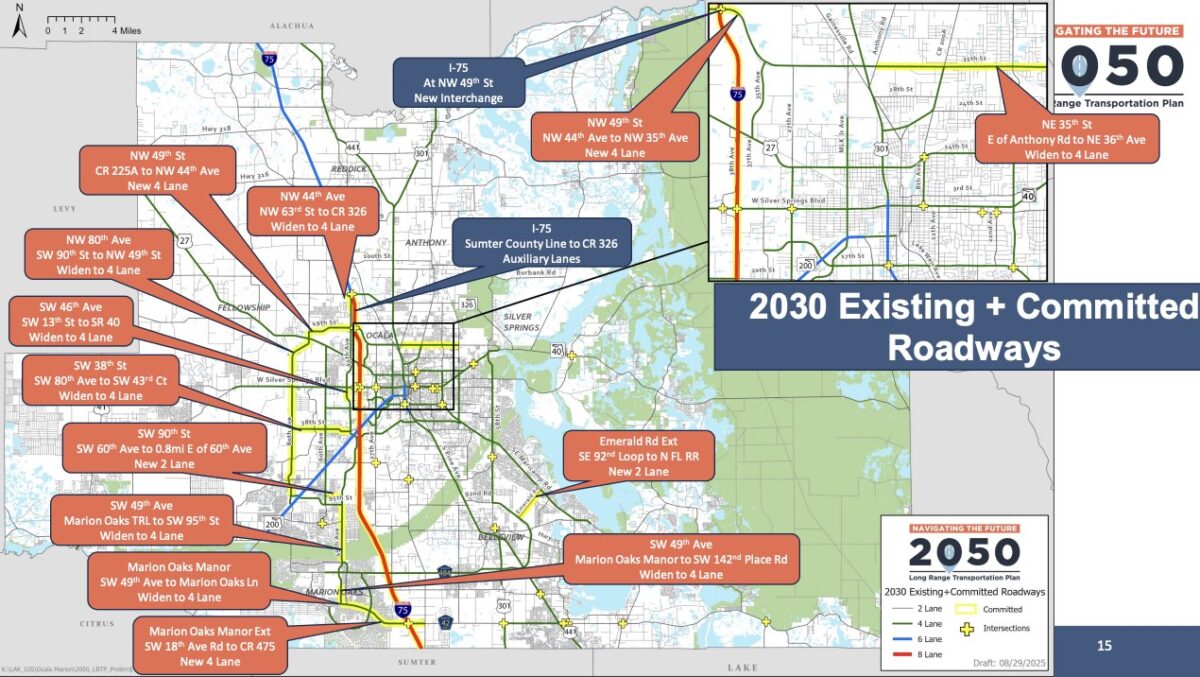
Marion County’s new transportation plans detail hundreds of millions of dollars that have been committed by the state and federal government to road-widening projects and other improvements that will be implemented over the next five years.
The Ocala/Marion Transportation Planning Organization will present its 2026-2030 transportation plan to the Marion Tourist Development Council during its regular meeting on Thursday.
During the presentation, the TPO will provide details on the county’s projects for its 2050 Long Range Transportation Plan (LRTP) and its Active Transportation Plan (ATP).
According to the county, the LRTP serves as a “comprehensive framework for guiding transportation improvements in Marion County over the next 25 years.” The ATP serves a framework for the improvement of “walking, biking, and trail facilities” in Marion County.
According to the TPO, the state is committing an estimated $347.9 million and the federal government is committing an estimated $192.6 million in funding for transportation improvement projects between 2026 and 2030.
The local match for that funding will be around $13.3 million, which represents around 2.4% of the $553.9 million in estimated project costs.
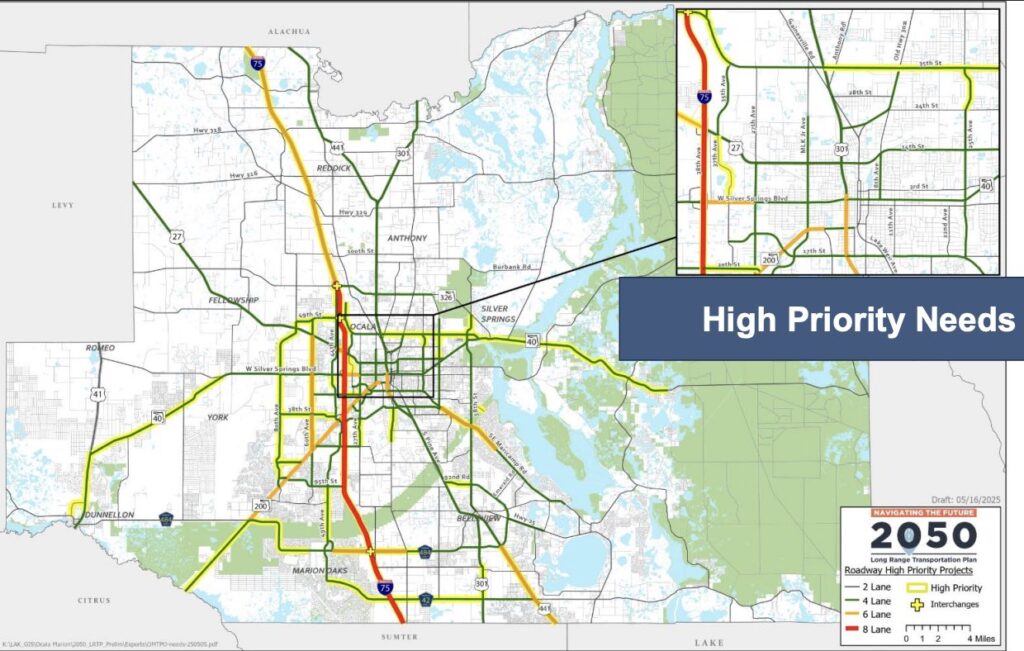
Multiple roadways across the city of Ocala and Marion County are identified in the report as having “high priority needs,” including Interstate 75, State Road 200, SE Maricamp Road, U.S. Highway 441/S Pine Avenue, and SW 60th Avenue, among others.
The projects for both plans cover all “modes of transportation,” including roadways, sidewalks, trails, “aviation,” and “transit.” In addition to resurfacing roadways, the list includes projects to improve capacity, operations, and safety, as well as the construction of new facilities.
Several of the improvements are planned for hotspots along Interstate 75, including the NW 49th Street interchange, the State Road 326 exit, and the extension of 31 miles of auxiliary lanes.
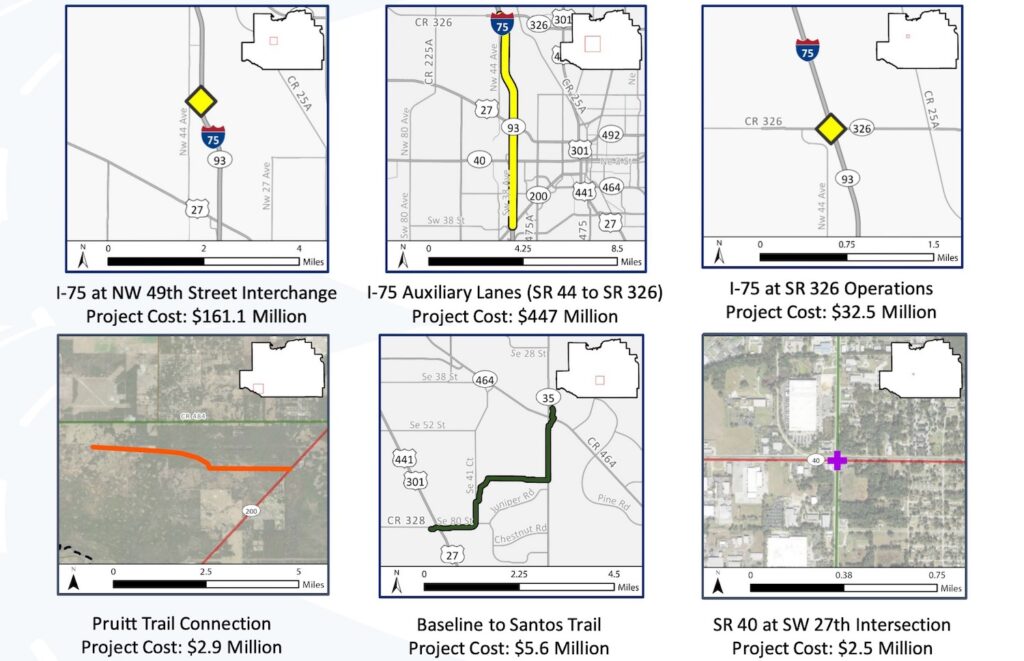
The 49th Street interchange project is situated next to the site where Ocala’s first Buc-ee’s will be constructed. That gas station chain recently released new plans detailing that facility.
The report also lists a slew of other existing or committed road-widening projects that should improve some of the most heavily-trafficked areas in Ocala.
That includes the widening of NW 49th Street, NW 80th Avenue, SW 46th Avenue, and Marion Oaks Manor, among other roadways.
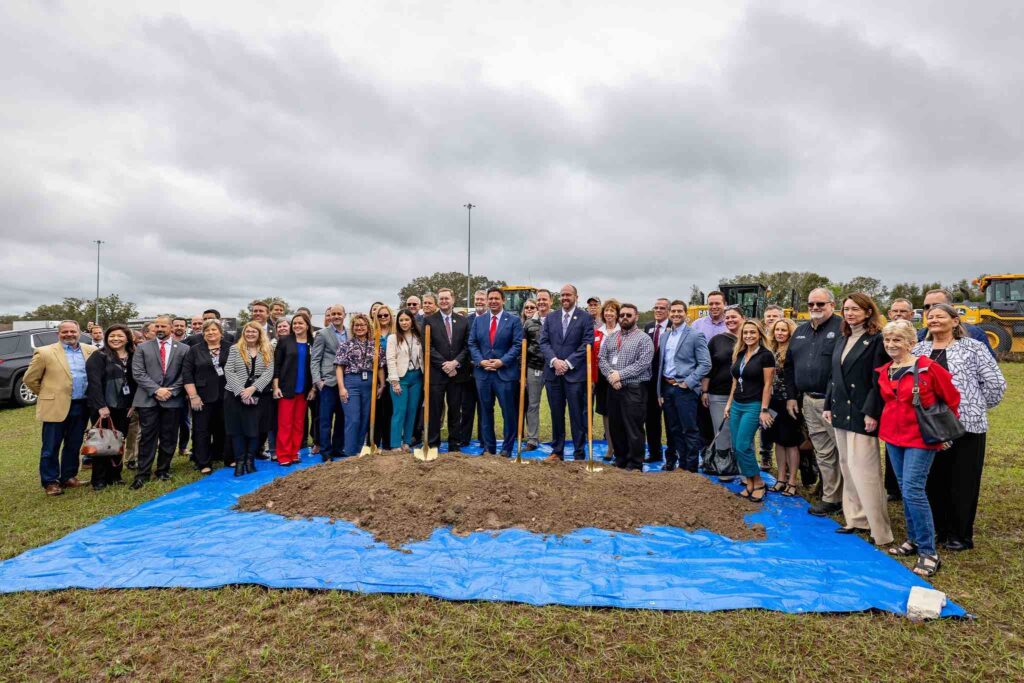
Earlier this year, Governor Ron DeSantis and local officials broke ground on the auxiliary lane improvements, which are estimated to cost approximately $447 million.
The transportation planning presentation also provides for details on the county’s long term considerations for transportation through the year 2050.
To that end, the TPO estimates that the population of Marion County will be approximately 588,400 by 2050, which represents an increase of over 161,000 residents over the county’s 2025 population estimate of 427,973. The TPO also estimates that 192,407 of those residents in 2050 will be employed, using local roadways to travel to and from work.
The county’s plans will be up for review over the coming weeks.
A public open house to discuss the drafts for both the LRTP and the ATP will be held at the Mary Sue Rich Center at Reed Place (1821 NW 21st Avenue, Ocala) on Tuesday, September 30, from 4 p.m. to 6:30 p.m.
The county will issue separate votes on the Active Transportation Plan and Long-Range Transportation Plan on October 28 and November 13, respectively.
To view the county’s transportation plans in their entirety, visit the Ocala/Marion Transportation Planning Organization online.
The Marion County Tourist Development Council next meets at the Ocala/Marion County Visitor and Convention Bureau (109 W Silver Springs Boulevard, Ocala) on Thursday, September 25, at 8 a.m.