
A fire that destroyed several blocks of Ocala’s downtown district in 1883, including newspaper files about a lot of Ocala and Marion County’s early history, was followed by a new era of brick buildings that formed “The Brick City.”
The “Great Fire” of Ocala took place on November 29, 1883. City records show that on that day, 2,000 individuals welcomed three special trains from the Florida Southern Rail Road to the Ocala area.
The fire broke out on top of Benjamin & Company, a two-story frame store located at the southeast corner of Main Street and Ocklawaha Avenue. Despite bucket brigade efforts beginning immediately, the fire spread quickly.
The flames moved to destroy Snowden’s Drugstore, the Ocala House Hotel, and Schlosser’s barber shop. All buildings on the east side of Main Street between Broadway and Fort King Avenue were consumed. The fire then turned westward across Main Street, destroying two more blocks to Orange Street.
Several notable buildings were destroyed by the fire, including the office of the former Banner, the predecessor to the Ocala StarBanner (Ocala-News.com has no affiliation with either publication), as well as the home of its editor. It also burned the Palace Hotel, the home of Dr. Thomas Gary, James H. Whitfield’s boarding house, and a mill that processed moss. All buildings on the east side of SE 1st Avenue from Silver Springs Boulevard to Fort King Street were destroyed.
In total, approximately ten stores were consumed by flames, and four blocks of the business district were left in ashes. The estimated losses caused by the fire were approximately $350,000, which equates to nearly $11 million in 2024. The fire left residents homeless and destroyed records and newspaper files containing a large portion of Ocala and Marion County’s early history.
According to city records, local residents began rebuilding almost immediately after the fire. Frame buildings were replaced by brick, granite, and metal, and the city developed its brick-front store building type due to the desirability of brick masonry as a fireproof construction material.
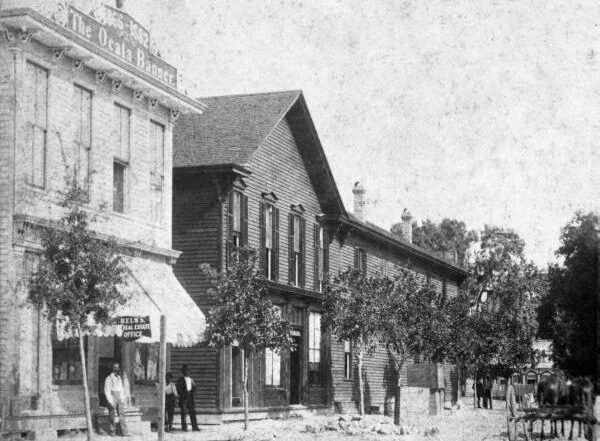
The immediate period following the fire saw rapid institutional development, with a new, modest courthouse completed in the Public Square in 1884. That same year, a much larger, three-story Ocala House of red brick was completed, featuring a tower and fronting Main Street.
Additionally, the city’s first two bank buildings were constructed, and the three-story Marion Opera House was erected at the southwest corner of Main Street and Broadway Street the year after the fire.
This quick rebuilding pace, aided by prominent Jacksonville merchants who established successful branch stores in Ocala, cemented the town’s status as a prosperous trade center.
By 1884, the town had several wholesale warehouses and more than 25 retail establishments.
Within five years of the event, Ocala became known throughout the state as “The Brick City.”
In addition to the moniker, the fire also led to the official creation of the city’s fire department. Within weeks of the incident, fire bonds were issued for $2,500 to fund a fire department.
On May 20, 1885, the Ocala City Council passed an ordinance establishing the Fire Department of the City of Ocala.
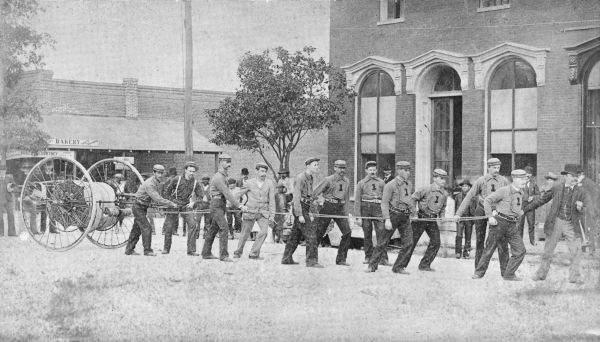
The volunteer firemen at the time were absorbed into the newly created fire department companies, which were named Marion Steam Fire Engine Company No. 1 and Ocala Hook & Ladder Company No. 1. They were helmed by William Fox, the city’s first fire chief.
In 2019, the city installed a fire bell in downtown Ocala that was used during its early years.

To read more about the history of the city of Ocala, visit the city’s Downtown Ocala Historic Context and History webpage.
Information from this story was obtained from the City of Ocala. Photos were obtained from the Florida State Library and Archives.